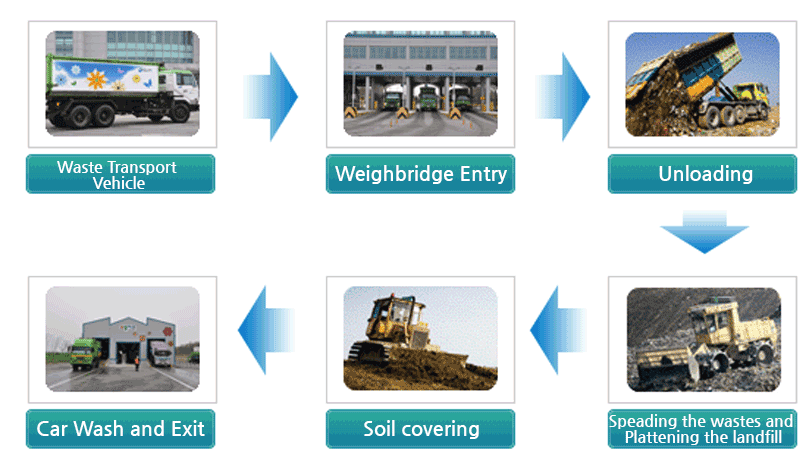
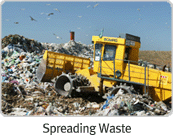
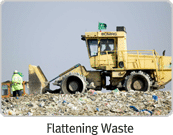
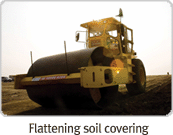
Soil Covering
The soil covering helps minimize environmental pollution of surrounding area and occurrence of leachate, and limits landfill gas and enhances the operation efficiency of waste transport vehicle entry and exit and of landfill equipment.
A) Effects of Soil Covering
- Contribute to minimizing waste exposure area and reducing its stench and waste dispersion.
- Contribute to reducing occurrence of leachate in case of heavy rain.
- Contribute to the loss of pest habitat like flies and mosquitoes.
- Contribute to block landfill gas.
- Contribute to increasing operational efficiency of waste transport vehicles and landfill equipment.
B) Daily Soil Covering
15cm - 20cm of soil is covered immediately after waste disposal is completed per day. Daily soil covering is placed over the waste to prevent dispersion and to minimize stench. At the 2nd Landfill Site, daily soil covering is placed timely (within 3 - 5 hours) after waste disposal
C) Intermediate Soil Covering
According to the “Laws of Waste Management”, if waste is not disposed at the landfill for more than 7 days, 30cm or thicker intermediate cover is required. However, at the 2nd Landfill Site, an intermediate cover of 50cm thickness is placed to isolate exposure to rain, landfill gas and other goals.
D) Final Soil Covering
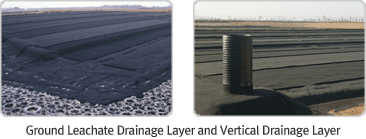
When a section of the landfill is finished or filled to capacity, it is permanently covered with a combination of a layer of topsoil, drainage layer, barrier layer, separation layer and gas drainage layer. The final soil covering of separation distance is implemented to prevent dispersion of landfill gas and to reduce occurrence of leachate due to rainwater infiltration when landfill is complete. The soil embankment is a generally enforced principle immediately before and after filling of landfill. The construction process is as follows: gas drainage layer, separation layer, barrier layer, drainage layer and topsoil layer.
- Gas Drainage Layer: 30cm laid after 30cm of intermediate layer is taken off
- Separation Layer: 300g/㎡ of non-woven layer laid to separate from gas drainage layer
- Barrier Layer: 45cm layer of soil over areas where coefficient of permeability is less than 1×10⁻⁶cm/sec within Sudokwon Landfill Site.
- Drainage Layer: Layer of geotextile (nonwoven 1,000g/㎡) over areas where soil covering load penetrating power is over 3.3×10⁻⁵㎡/sec.




 Home
Home